
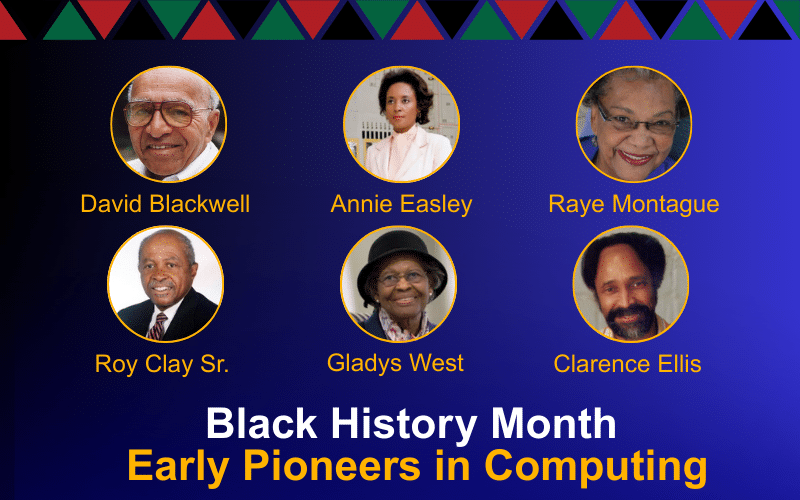
Six portraits of Black computing pioneers—David Blackwell, Annie Easley, Raye Montague, Roy Clay Sr., Gladys West, Clarence Ellis—are featured for Black History Month, honoring Early Pioneers in Computing.
This year for Black History Month, CMD-IT recognizes the early pioneers in computing whose brilliance, perseverance, and innovation helped shape the technological foundation we rely on today. Long before computing became a mainstream field, Black technologists were solving complex problems, advancing research, and breaking barriers, often without recognition. Their contributions not only transformed computing but also paved the way for future generations of scholars, researchers, and professionals in technology. Below are a few Black early pioneers in computing.
David Blackwell: A Foundation of Mathematical Excellence
David Blackwell was a trailblazing mathematician and statistician whose work laid critical groundwork for modern computing, probability theory, and game theory. As the first Black scholar inducted into the National Academy of Sciences, Blackwell’s research continues to influence artificial intelligence, decision theory, and data-driven systems. His legacy underscores the importance of rigorous mathematical foundations in today’s computing and AI advancements. The NVIDIA graphics processing unit Blackwell is named in honor David Blackwell.
Roy Clay Sr.: The Godfather of Silicon Valley
Often referred to as the “Godfather of Silicon Valley,” Roy Clay Sr. played a pivotal role in the early days of computer engineering. He led software development efforts for Hewlett-Packard’s first computer and later founded a consulting firm that supported major technology companies. Clay was also a fierce advocate for diversity in tech, mentoring young Black engineers and opening doors in an industry where representation was scarce.
Annie Easley: Powering Innovation at NASA
Annie Easley was a computer scientist, mathematician, and rocket scientist whose work at NASA contributed to energy technologies, battery systems, and early spaceflight software. Beginning her career as a human “computer,” Easley transitioned into programming as the field evolved demonstrating adaptability and technical excellence. Her work remains influential in areas such as alternative energy and space exploration.
Gladys West: Mapping the World Through Data
Gladys West’s mathematical modeling and data analysis were instrumental in the development of the Global Positioning System (GPS). At a time when computing resources were limited, her work with satellite geodesy helped accurately map the Earth’s shape, making modern navigation systems possible. Her contributions exemplify how behind-the-scenes computational research can have global, everyday impact.
Raye Montague: Revolutionizing Naval Computing
Raye Montague was a pioneering computer programmer whose innovations transformed naval ship design. She developed the first computer-generated rough draft of a U.S. Navy ship, dramatically reducing design time from years to hours. Montague’s work demonstrated the power of computing to streamline complex engineering processes and set new standards for efficiency and innovation.
Clarence “Skip” Ellis: Collaboration Before the Internet
Clarence Ellis was the first Black person to earn a Ph.D. in computer science. His research focused on groupware and collaborative computing concepts that are foundational to today’s remote work tools, shared documents, and distributed systems. Ellis’s vision of technology as a tool for collaboration continues to shape how people work and connect in the digital age.
Honoring Legacy, Advancing the Future
The stories of David Blackwell, Roy Clay, Annie Easley, Gladys West, Raye Montague, and Clarence Ellis remind us that Black excellence has always been integral to the field of computing. Their achievements laid the groundwork for modern technologies from AI and data science to collaborative platforms and global navigation.
At CMD-IT, recognizing these pioneers is more than a reflection on the past, it is a commitment to advancing their legacy by strengthening the pipeline, supporting leadership development, and ensuring that future innovations are shaped by diverse voices. As we celebrate Black History Month, we recognize that the future of computing is built on the contributions of those who came before and the leaders we continue to uplift today.